“Talks a lot, doesn’t say much.” My friend Jason* once said quite casually and earnestly about Ron*, another mutual friend of ours.
(*not their real names)
This remains one of the most brutal friend-on-friend takedowns I’ve witnessed to this day.
So how does this relate to GenAI? Well, I think GenAI is infecting us with a similar malaise to Ron*.
(*still not his real name)
The problem is that AI has scaled a particular type of poor writing. And I do not mean hallucinations. Sure, hallucinations are problematic and prevalent; but this is an engineering problem that is being tackled through search, RAG and so on.
The most common problem is the lack of “originality density” - loosely defined as “the ratio of your personal thought to total word count”
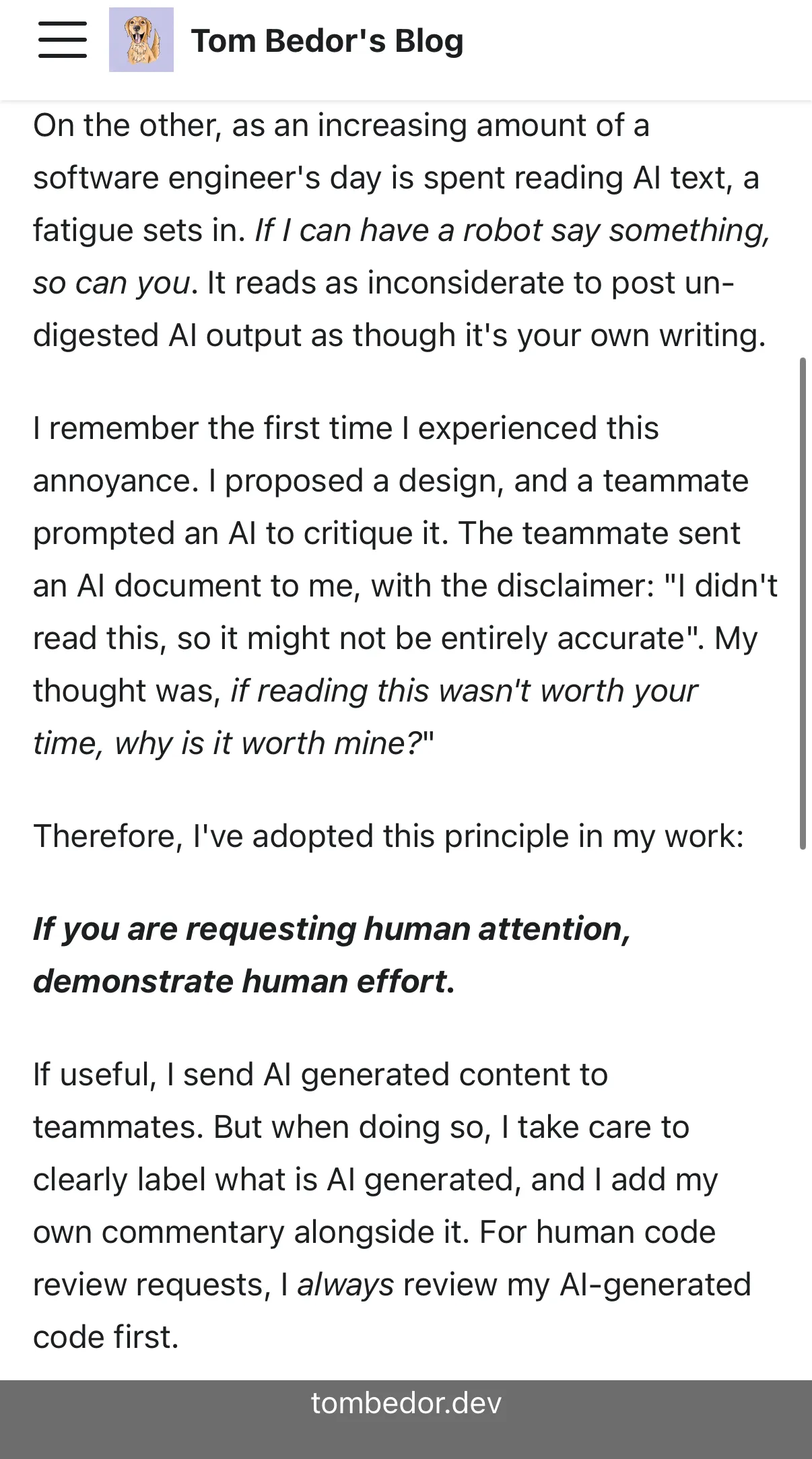
This idea crystallized for me when I saw Tom Bedor’s blog doing the rounds on HackerNews. His key sentiment “if you are requesting human attention, demonstrate human effort” is a great point. But why does effort matter? Well, I think it matters because effort is a proxy for originality - it’s how we inject something of ourselves into the writing.
Consider this scenario:
You have never visited Spain; but I’ve just come back from a lovely holiday there, so I prompt my favourite LLM:
Write an email to Steph* encouraging them to visit Spain(*Probably not your name)
And then send you the resulting 4,000-word report, verbatim.
What value does that provide to you?
The best case scenario is that you don’t have access to an LLM, and you’ve got a free credit’s worth of LLM usage.
If you do have access to an LLM, the value of this “work” becomes negligible or zero. I could have just sent you a note like “Spain is great, you should go” - and then suggested that you can use an LLM to do more research.
Now, what if I prompted the model like this:
I had a great time in Madrid last week in late May. I enjoyed the warm weather, delicious Spanish food, the opportunity to watch football, and practice my Spanish.

I want to encourage my friend Steph* to go there - they like all of those things.

Write a draft email for me to edit and send to Steph, highlighting these - especially the food. The Jamón, Pulpo a la gallega and pimientos de Padrón were my highlights. (Please describe these briefly)(*Probably still not your name)
Then edit the resulting draft, we’re probably getting closer to a result that has real value to you.
It would contain:
- Concrete reasons why I enjoyed Madrid
- Why that may be a good predictor for your experience
- Descriptions of the foods that I enjoyed
If I bothered to spend the time, it could even contain humorous anecdotes of my time there, or little references to how you, Steph* and I often enjoy the same holiday destinations. (*If Steph is not your name, would you consider a change?)
Even when expanded out by an LLM, a majority of the expansion will be in support of my original theses and ideas. In other words, the “originality density” of this would remain high. A generic LLM would not be able to reproduce this easily, as it is based on a detailed set of my thoughts and ideas.
This is where we really perceive the “effort” in writing, as Bedor points out. Without it, you’re just passing on a short prompt inflated by a model. Instead of sending 50 words of original thought, the readers are buried in 2,500 words of filler - decreasing the “originality density” by a factor of 50.
This is the modern-day equivalent of handing someone in 2026 a 100-page street directory with highlighted paths. What’s useful is someone I trust telling me which streets are interesting, and then I can navigate on Google Maps.
Don’t be a Ron*. I’ll respect the readers’ time as an author. You should too.
(*If that is your name - there’s probably little you can do at this point; so just don’t be THE Ron^ from this story)
(^not real name)